


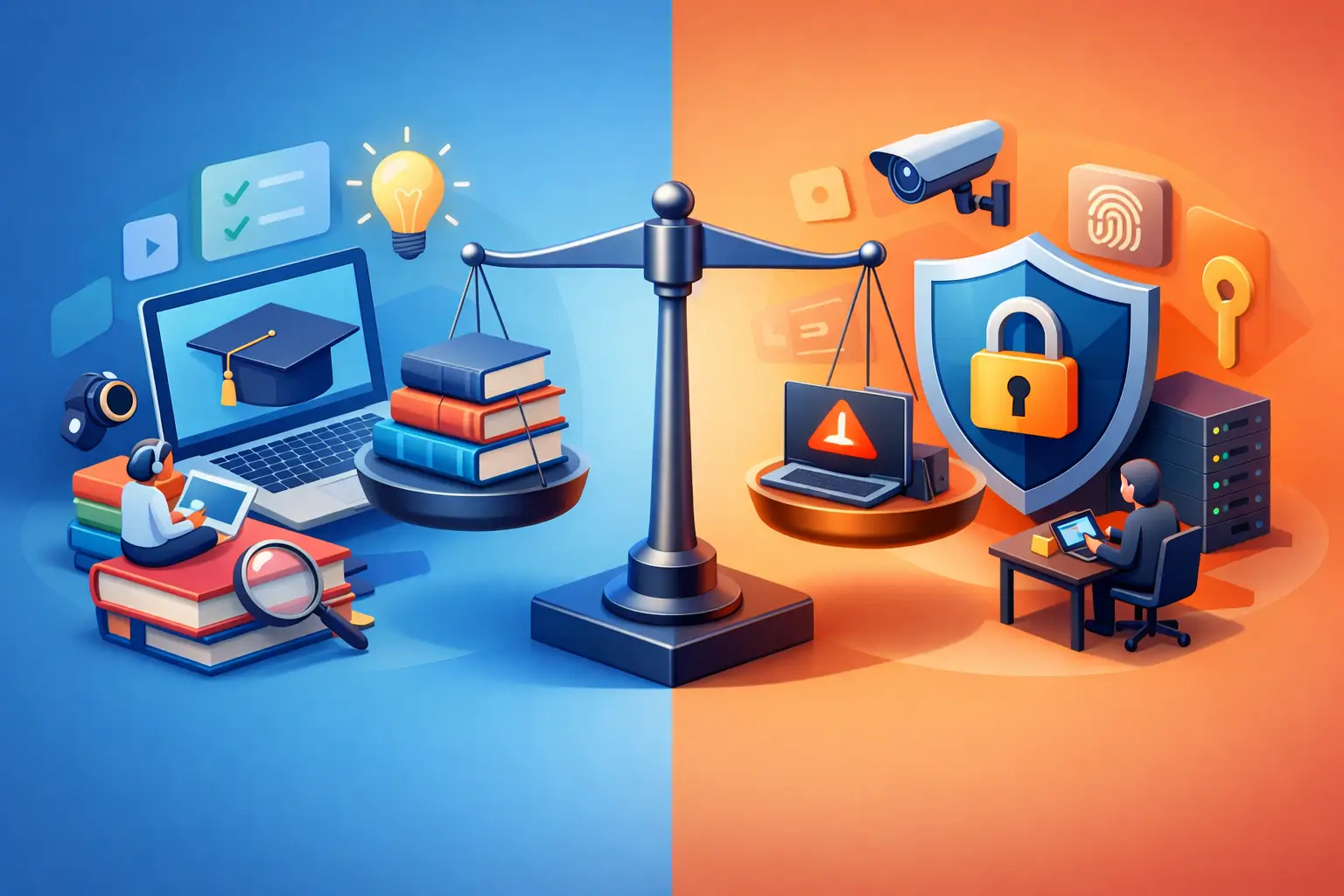
LMS vs Security Training: What Matters More?
A lot of companies ask the wrong first question. They compare LMS vs security training as if they are competing products, then wonder why the rollout stalls, completion rates stay flat, and risky behavior does not change.
The real issue is simpler. An LMS is infrastructure. Security training is a risk-reduction program. One helps you deliver learning. The other exists to change employee behavior, support compliance, and lower the chances of costly human error. If you treat them as interchangeable, you usually get the administrative benefits of training without the security outcomes.
LMS vs security training: the core difference
An LMS, or learning management system, is designed to assign, track, and report on learning content. It is useful for onboarding, HR policies, leadership development, certifications, and broad corporate education. It gives teams a way to organize learners, manage enrollments, monitor completions, and document progress.
Security training has a narrower and more critical mission. It is built to reduce cyber risk by teaching employees how to recognize threats, make safer decisions, and respond appropriately in real situations. In regulated industries, it also helps prove that the organization is meeting policy and compliance requirements.
That distinction matters because the success criteria are different. A general LMS is often measured by adoption, content availability, and administrative efficiency. Security training is measured by whether people stop clicking suspicious links, report incidents faster, follow policy correctly, and understand the security responsibilities tied to their role.
Why companies confuse the two
The confusion usually starts with procurement. A business already has an LMS, so the next assumption is that it can handle cybersecurity awareness too. Technically, it can host a course. That does not mean it can deliver an effective security training program.
This is where many organizations lose momentum. They upload a generic annual awareness module into the LMS, assign it to everyone, collect completions, and check the compliance box. On paper, the program exists. In practice, employees retain little, leaders get weak visibility into behavior change, and the organization remains exposed.
That does not mean the LMS was a bad decision. It means the company used a learning tool to solve a security problem without enough security-specific design behind it.
What an LMS does well
A strong LMS is valuable, especially in larger organizations with multiple training needs. It centralizes administration, supports user provisioning, tracks course progress, and creates a record for audits. For HR and L&D teams, that structure matters.
It also works well when cybersecurity education needs to fit into an existing enterprise learning environment. If your priority is consistency across all internal training categories, an LMS can support that operating model. It can help standardize assignments by department, region, or job level.
For some organizations, that is enough. If security awareness requirements are basic, budgets are tight, and internal teams can build or source quality content, the LMS may be a practical delivery layer.
But that is the limit of the argument. Delivery is not the same as effectiveness.
What security training does well
Security training is designed around real threats, not just course administration. It focuses on phishing, password security, social engineering, data handling, incident reporting, device safety, remote work risk, and role-based responsibilities. More mature programs also align content to regulatory obligations, internal policy, and regional threat realities.
That specialization matters because security behavior is highly contextual. A finance team needs training that reflects invoice fraud and business email compromise. Executives need modules that address impersonation, travel risk, and high-value targeting. Developers, customer support teams, and HR each face different attack paths and compliance concerns.
Good security training also reinforces learning over time. Cyber risk does not drop because someone watched one video in March. Behavior changes when training is relevant, repeated, measurable, and tied to the actual decisions employees make every week.
That is why dedicated security training programs often include interactive modules, assessments, certifications, and content mapped to frameworks or regulations. They are not just teaching people what security is. They are preparing the workforce to act as a line of defense.
LMS vs security training in compliance-driven environments
If your organization is dealing with NIS2, sector-specific requirements, customer assurance demands, or board-level scrutiny, the gap becomes even more obvious.
An LMS can store evidence that training happened. That is useful. But compliance-driven security education often requires more than attendance records. It needs role relevance, jurisdictional alignment, current subject matter, and demonstrable coverage across the workforce.
For organizations operating across the US, Europe, or the GCC, training may also need localization. Language, examples, regulatory context, and business norms affect whether employees understand and apply what they learn. Generic content delivered through a standard LMS may satisfy a narrow training task, but it often misses the operational reality of multinational compliance.
Security leaders know the difference between proving a module was assigned and proving the organization is building resilience.
The real trade-off: convenience vs risk reduction
This is where the LMS vs security training debate becomes practical. The choice is not really about platform preference. It is about what outcome matters most.
If your main goal is administrative simplicity, your LMS may be enough for basic awareness delivery. If your goal is measurable risk reduction, stronger reporting for security leadership, and content that reflects regulations and threat trends, dedicated security training is the better fit.
There is also a middle path. Many organizations use both. They keep the LMS as the enterprise learning hub while using specialized cybersecurity training content or a dedicated provider for the substance of the program. That approach can work well when internal stakeholders need centralized reporting, but security leadership also needs depth, relevance, and faster content updates.
The right answer depends on your maturity, regulatory pressure, internal resources, and threat exposure. A 200-person company with limited compliance obligations does not need the same setup as a multinational operating in a regulated sector.
Questions leaders should ask before deciding
Before choosing between an LMS-only approach and a dedicated security training program, decision-makers should pressure-test the business need.
Start with risk. What human behaviors are causing the most exposure today? Phishing clicks, poor password habits, weak data handling, delayed reporting, and shadow IT all point to different training priorities.
Then look at compliance. Do you need simple proof of completion, or do you need role-based, regulation-aligned training that can stand up to customer, auditor, or board scrutiny?
Next, assess internal capacity. Who will maintain the content, update it as threats change, localize it for different teams or regions, and measure whether behavior is improving? Many companies assume they can manage this internally until the maintenance burden becomes obvious.
Finally, ask what success should look like six or twelve months from now. If the answer is only “100 percent completion,” the program is being set up for low impact. If the answer includes fewer avoidable incidents, better reporting rates, stronger audit readiness, and clearer executive visibility, then the training strategy needs to be built differently.
When an LMS is enough - and when it is not
An LMS is enough when cybersecurity education is low-complexity, the audience is narrow, and the company only needs a basic delivery and tracking mechanism. It can also be enough as a temporary solution while a broader security education strategy is being built.
It is not enough when the organization faces active phishing risk, operates under meaningful compliance obligations, needs localized or role-based training, or wants evidence that employee behavior is improving. In those cases, treating cybersecurity awareness as just another course category creates a false sense of coverage.
Cybersecurity starts with people, not tools. That applies to training decisions too. The platform matters, but the design, relevance, and operational impact matter more.
For many organizations, the smartest move is not choosing LMS or security training as if one replaces the other. It is deciding whether your current training model is actually reducing risk. If it is not, the problem is not your completion report. It is the gap between learning administration and security readiness.
Build the program around the threat, the workforce, and the regulations you actually face. The technology should support that mission, not define it.
ADVANCED VISION IT - MALTA Address: Suite 8, Ta’ Mallia Buildings, Triq In‑Negozju, Zone 3, Central Business District, Birkirkara, CBD 3010, Malta
Registration number: C111282, VAT Number: MT31713827
Phone:+35679224404
Email: office@advisionit.com
ADVANCED VISION IT - BULGARIA
Address: 35 Dimitar Hadzhikotsev str. Ent A, Lozenets, Sofia, Bulgaria
ID No: 205789039, VAT No: BG205789039
Phone: +359 888 258 530
Email: office@advisionit.com